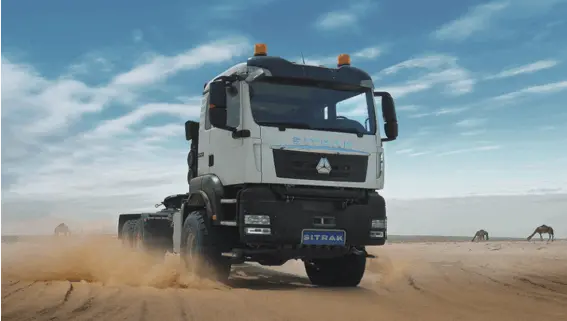
 A tractor truck is essential for long-distance freight, container transport, construction, and other heavy-duty operations. The right choice can lower operating costs, improve fuel efficiency, and keep your fleet running with less downtime.
Key factors include road conditions, transport requirements, vehicle configuration, engine power, key components, brand, and new vs. used. This guide covers the main points to consider when selecting a tractor unit for your business.
What Is a Tractor Truck?
A tractor unit is a heavy-duty truck designed to pull a semi-trailer through a fifth-wheel coupling. Unlike a rigid truck, it can be connected to different types of trailers for various transport needs.
For a more detailed explanation of its structure, types, and applications, read our Tractor Truck: The Complete Encyclopedia
Choose a Tractor Truck Based on Road Conditions and Transport Needs
First, determine the truck’s specific location and operating conditions. A tractor unit that performs well on paved roads may not be suitable for mountain roads, construction sites, or poorly maintained routes.
For transport operations on well-maintained roads, a 4×2 or 6×2 tractor unit is generally a suitable choice. Under these conditions, buyers can place greater emphasis on fuel efficiency, cruising performance, and driver comfort rather than maximum traction.
For transport on mountain roads, steep slopes, or poorly maintained roads, a 6×4 tractor unit is generally more suitable. Its two driven rear axles provide better traction and load distribution, helping the truck maintain stable performance under demanding road conditions.
If you need to purchase a tractor truck, please visit our product list.
Choose the Right Configuration
Axle configuration affects traction, load capacity, fuel efficiency, and operating cost. The right choice should be based on your typical load, road conditions, and transport requirements.
4×2 Tractor Truck
A 4×2 tractor truck has two axles with one driven rear axle. It is lighter, simpler, and generally more fuel-efficient than configurations with additional drive axles.
If your transport operation mainly involves paved highways, standard container transport, general freight, and moderate loads, a 4×2 tractor truck is usually a practical choice.
6×2 Tractor Truck
A 6×2 tractor truck has three axles but only one driven rear axle. The additional axle helps improve weight distribution while still maintaining relatively good fuel efficiency.
If your operation requires higher axle capacity for regional or long-distance highway transport, but does not require the extra traction of two driven rear axles, a 6×2 tractor truck can be a suitable option.
6×4 Tractor Truck
A 6×4 tractor truck has three axles with two driven rear axles, providing stronger traction and better performance under heavy loads or difficult road conditions.
If your transport business involves heavy trailers, mountain roads, steep gradients, poorly maintained roads, or demanding construction-related transport, a 6×4 tractor truck is generally the better choice.
| Configuration | Axles & Driven Axles | Key Strengths | Best For |
| 4×2 | 2 axles, 1 driven rear axle | Lighter, simpler, more fuel-efficient | Paved highways, standard container transport, general freight, moderate loads |
| 6×2 | 3 axles, 1 driven rear axle | Better weight distribution, relatively good fuel efficiency | Regional or long-distance highway transport requiring higher axle capacity |
| 6×4 | 3 axles, 2 driven rear axles | Stronger traction, better performance under heavy loads or difficult conditions | Heavy trailers, mountain roads, steep gradients, poorly maintained roads, construction-related transport |
Choose the Right Engine Power and Key Components
When preparing to purchase a tractor unit, you should also pay attention to the engine’s horsepower and other key components.
Engine Horsepower
If your tractor truck is mainly used for standard freight on relatively flat highways, moderate engine power is usually sufficient—excessive horsepower may increase purchase price and fuel consumption without a clear operating advantage.
If your operation involves heavy loads, mountain roads, long uphill sections, a higher-horsepower engine is recommended, as these conditions require stronger power and sufficient low-speed torque for stable performance under load.
For many heavy-duty tractor trucks, 350–500+ HP is common, but the right horsepower should always be matched to actual load and conditions rather than simply choosing the highest available option.
Fuel Tank Capacity

If your tractor truck is mainly used for short-distance or regional transport with easy access to fuel stations, a standard fuel tank is generally sufficient.
If your operation involves long-distance or cross-border transport, especially on routes where fuel stations are limited, a larger fuel tank is recommended. Greater fuel capacity can extend the driving range and reduce the number of refueling stops, helping improve transport efficiency.
Cab Type
 If your tractor truck is mainly used for local or regional transport and the driver returns to the base each day, a day cab is usually the more practical choice.
 If your operation involves long-distance or cross-border transport and the driver may need to stay in the truck overnight, a sleeper cab is recommended.
Consider the Tractor Truck Brand
Major tractor truck manufacturers offer different advantages in terms of price, fuel economy, technology, durability, and service support.
Chinese brands such as SINOTRUK HOWO, SHACMAN, and FAW are widely used in international freight and heavy-duty applications, particularly where buyers are looking for a balance between purchase price and heavy-duty capability.
European manufacturers such as Volvo, Scania, and Mercedes-Benz are also widely recognized for long-haul performance, driver comfort, advanced technology, and fuel efficiency.
When comparing brands, look beyond the logo and consider:Purchase price, Engine and transmission configuration,Fuel consumption, Parts availability, Local dealer or service network, Maintenance costs, Warranty,Resale value.
For trucks operating far from major service centers, parts availability can sometimes be more important than having a more advanced specification.
New vs Used Tractor Trucks
A new tractor truck is generally the better choice for buyers who prioritize reliability, warranty coverage, and lower maintenance risk.
A used tractor truck usually has a lower purchase price and may be suitable for buyers with a limited budget or lighter operating requirements. However, the vehicle’s mileage, maintenance history, engine, transmission, axles, and overall condition should be carefully checked before purchase.
The final choice should depend on your budget, expected annual mileage, operating conditions, and acceptable maintenance risk.
Tractor Truck Prices
Price is also an important factor when choosing the right tractor truck. There is a significant price difference between new and used tractor trucks.Generally, new tractor trucks cost between $15,000 – $100,000, while used tractor trucks range from $8,000 – $50,000. Tractor truck prices vary depending on the brand, model, specifications, vehicle condition, and region.
FAQ
What is the difference between a tractor truck and a regular truck?
A tractor truck only pulls a trailer and does not carry cargo itself. A regular rigid truck carries cargo on its own chassis.
Can a tractor truck operate without a trailer?
Yes, it can be driven without a trailer, but it cannot carry cargo on its own. It is designed to pull a trailer.
Conclusion
Choosing the right tractor truck depends on your transport needs, road conditions, vehicle configuration, engine power, key components, brand, and budget.Match these factors to your actual operation to improve fuel efficiency, reduce downtime, and achieve better long-term value.